10 Warning Signs Your Denver Water Heater Is About to Fail
A broken water heater rarely announces itself on a sunny Saturday afternoon when you have plenty of free time. More often, it fails at 6:00 AM on a freezing January morning in Denver, just as you step into what should be a steaming shower, or worse—it ruptures quietly in your basement while you are at work, soaking drywall, carpeting, and stored belongings with 50 gallons of rust-colored water.
Living along the Front Range of Colorado places unique physical demands on domestic water heating systems. Our high elevation (5,280 feet in Denver and nearly 6,000 feet in [Highlands Ranch](/service-areas/highlands-ranch/)), winter incoming groundwater temperatures that plummet below 40°F, and moderately hard mountain runoff water combine to accelerate component wear and internal corrosion.
In this comprehensive troubleshooting guide, we review the top 10 warning signs that your water heater is nearing the end of its life, explain why they occur, and guide you on what to have ready when you call for professional assistance.
1. Age of the Water Heater: Past the 10-Year Benchmark
The single most reliable indicator of impending failure is simple calendar age. Conventional storage tank water heaters have an average design lifespan of **8 to 12 years**. While some well-maintained units reach 14 or 15 years, running a water heater past 10 years without frequent inspections is living on borrowed time.
How to Find Your Unit's Age Inspect the manufacturer rating plate on the side of the tank. Find the serial number: - **Bradford White**: Uses a two-letter year and month code (e.g., 'G' for 2010). - **Rheem & Ruud**: The first four digits encode month and year (e.g., '0514' = May 2014). - **A.O. Smith & State**: Often encode the year in digits two and three (e.g., '1522...' = 2015).
If your water heater is over 10 years old and showing any secondary symptoms below, scheduling a planned [Water Heater Replacement](/water-heater-replacement-denver/) will save you thousands compared to an emergency cleanup.
2. Rusty, Discolored, or Metallic-Tasting Hot Water
If brown, red, or cloudy water flows from your hot water taps—while cold water taps run crystal clear—the interior steel wall of your water heater tank is actively rusting.
Water heaters feature a steel shell protected by an interior porcelain enamel "glass" lining and a sacrificial anode rod. Over time, Denver's mineral-laden water completely consumes the anode rod. Once the rod is gone, the water begins eating directly into the structural steel tank. Once rust penetrates the inner cylinder, catastrophic tank rupture is inevitable.
3. Loud Popping, Rumbling, or Banging Noises
Do you hear strange knocking, banging, or crackling sounds echoing up from your basement whenever the water heater kicks on? Homeowners often describe this as "rocks tumbling inside the tank" or a "boiling teakettle."
This noise is caused by **sediment calcification**. As hard water is heated repeatedly, calcium and magnesium carbonates precipitate out of solution and settle on the bottom of the tank. Over several years, this creates a dense, hardened sediment crust up to four inches thick.
When the gas burner fires beneath the tank, water trapped underneath this sediment barrier superheats to boiling, creating steam bubbles that violently burst through the mineral layer. If left unresolved, this thermal stress fractures the glass tank lining. Schedule a professional [Water Heater Flushing](/water-heater-flushing-denver/) immediately to clear this debris before the tank cracks.
4. Moisture, Weeping, or Standing Water Around the Base
Any water pooling around your heater demands immediate attention. Even a small ring of moisture can indicate a pinhole leak in the tank vessel that is weeping through the outer insulation blanket.
Where is the Water Coming From? 1. **Top Fittings**: Check the cold inlet and hot outlet dielectric unions. If the leak is above the tank, a plumber can replace the flex lines. 2. **Temperature & Pressure Relief (T&P) Valve**: Located near the top or side with a copper or CPVC discharge pipe. If water is dripping from the pipe, the valve is either failing or venting dangerous thermal expansion. 3. **Drain Valve at the Bottom**: Plastic drain valves can become brittle and drip. 4. **Bottom Tank Seam**: If water is seeping from under the metal jacket, the tank has perforated. You need immediate [Emergency Water Heater Repair](/emergency-water-heater-repair-denver/).
5. Hot Water Runs Out Far Faster Than It Used To
If your household used to enjoy three consecutive showers without issue, but now the hot water turns lukewarm halfway through the second shower, your heating capacity has degraded.
- **On Electric Water Heaters**: This usually indicates a burned-out lower heating element. The upper element continues heating the top third of the tank, providing a brief burst of hot water that depletes almost immediately. An [Electric Water Heater Repair](/electric-water-heater-repair-denver/) can replace the lower element and restore full capacity.
- **On Gas Units**: A snapped or cracked cold-water dip tube is a frequent cause. When the dip tube breaks inside the tank, incoming 40°F cold water empties directly at the top of the tank, mixing immediately with the hot water feeding your shower.
6. The Gas Pilot Light Keeps Going Out
On gas water heaters, a pilot light that repeatedly extinguishes is one of the most frustrating homeowner headaches. While strong drafts down your chimney flue can blow out a standing flame, repeated outages point to a worn **thermocouple**, a clogged pilot orifice tube, or a defective gas control valve.
Learn more about safe relighting protocols and when professional help is needed on our [Water Heater Pilot Light Repair](/water-heater-pilot-light-repair-denver/) guide. Never use tape or force the gas knob down if the flame refuses to catch.
7. Fluctuating Temperatures and Lukewarm Output
Water that fluctuates wildly between scalding hot and lukewarm during a single shower indicates failing thermostat sensors or severe internal scaling. In tankless water heaters, this is often called the "cold water sandwich" and is typically triggered by a sticking flow sensor turbine or heavy scale build-up inside the heat exchanger. A targeted [Tankless Water Heater Repair](/tankless-water-heater-repair-denver/) can clean sensors and restore consistent water temperatures.
8. High Utility Bills Without Increased Usage
Have your Xcel Energy natural gas or electric bills spiked over the last two billing cycles with no change in your family's routine? A water heater struggling against a dense sediment barrier must burn significantly more gas or run electric elements 50% longer just to heat the same volume of water. Regular [Water Heater Maintenance](/water-heater-maintenance-denver/) keeps heating elements operating at peak efficiency.
9. Visual Corrosion on Pipes and Valves
Inspect the top of your water heater every few months. Do you see green copper oxidation, white crusty calcium deposits, or rust around the water nipples? This is known as galvanic corrosion, which occurs when dissimilar metals (like copper and steel) are connected without proper dielectric unions. Over time, this corrosion eats away threads, leading to sudden high-pressure spray leaks.
10. The Relief Valve Is Dripping or Discharging
The Temperature and Pressure Relief (T&P) valve is the primary safety mechanism preventing your water heater from turning into a dangerous pressurized vessel. If it discharges water onto the floor or makes a continuous hissing sound, pressure inside your tank has exceeded 150 PSI or water temperature has exceeded 210°F. This is an urgent safety issue—shut off the heater and call a licensed plumber.
Emergency Prevention Checklist for Denver Homeowners
| Step | Action Required | Why It Matters |
|---|---|---|
| 1. Shutoff Valve Check | Locate the cold water valve above the heater. Verify it turns freely. | Allows you to shut off water in 10 seconds if a tank bursts. |
| 2. Drain Pan Installation | Ensure an aluminum or plastic drain pan is under the tank. | Protects subflooring and finished basements from leak damage. |
| 3. Thermal Expansion Tank | Check that an expansion tank is installed above the unit. | Absorbs pressure spikes caused by closed municipal meters. |
| 4. Annual Anode Check | Have a plumber inspect the sacrificial anode every 2–3 years. | Prevents water from eating through steel tank walls. |
| 5. Temperature Setting | Set thermostat dial to 120°F. | Prevents accidental scalds and slows sediment buildup. |
What Callers Should Have Ready When Requesting Help
When you call our local Denver dispatch line at **(456) 789-0123**, having the following details on hand allows our independent licensed plumbers to arrive prepared with the exact parts or replacement tank needed:
- **Brand and Model**: Check the rating label (e.g., Bradford White, Rheem, A.O. Smith, Navien).
- **Fuel Source**: Natural Gas, Propane, Electric 240V, or Hybrid Heat Pump.
- **Approximate Age**: How many years has the unit been in service?
- **Primary Symptom**: Active water leak, zero hot water, rumbling sounds, or pilot won't stay lit.
- **Basement Access**: Let the dispatcher know if the unit is located in a tight crawlspace, closet, or open basement.
Whether you live in [Aurora](/service-areas/aurora/), [Lakewood](/service-areas/lakewood/), [Arvada](/service-areas/arvada/), [Westminster](/service-areas/westminster/), or [Centennial](/service-areas/centennial/), our licensed plumbing network is on call to restore your hot water quickly and safely.
On-Site Field Testing & Diagnostic Standards
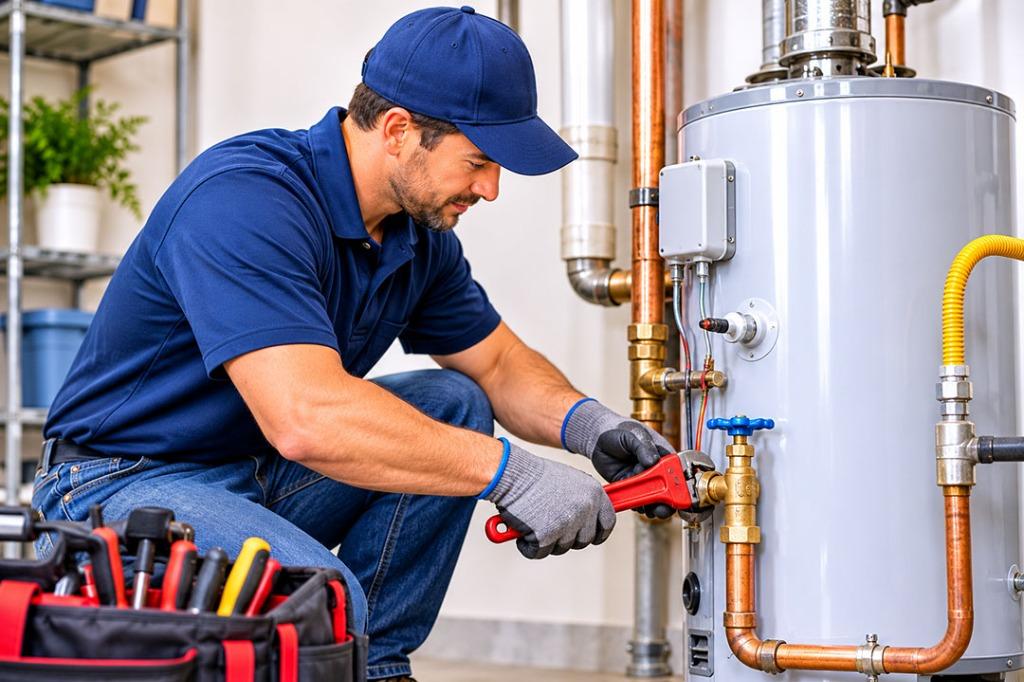
Denver plumbers verify water pressure, high-altitude gas combustion ratios, and electrical continuity before recommending part replacements. If you suspect your water heater is failing, call for an immediate on-site inspection.